Notely
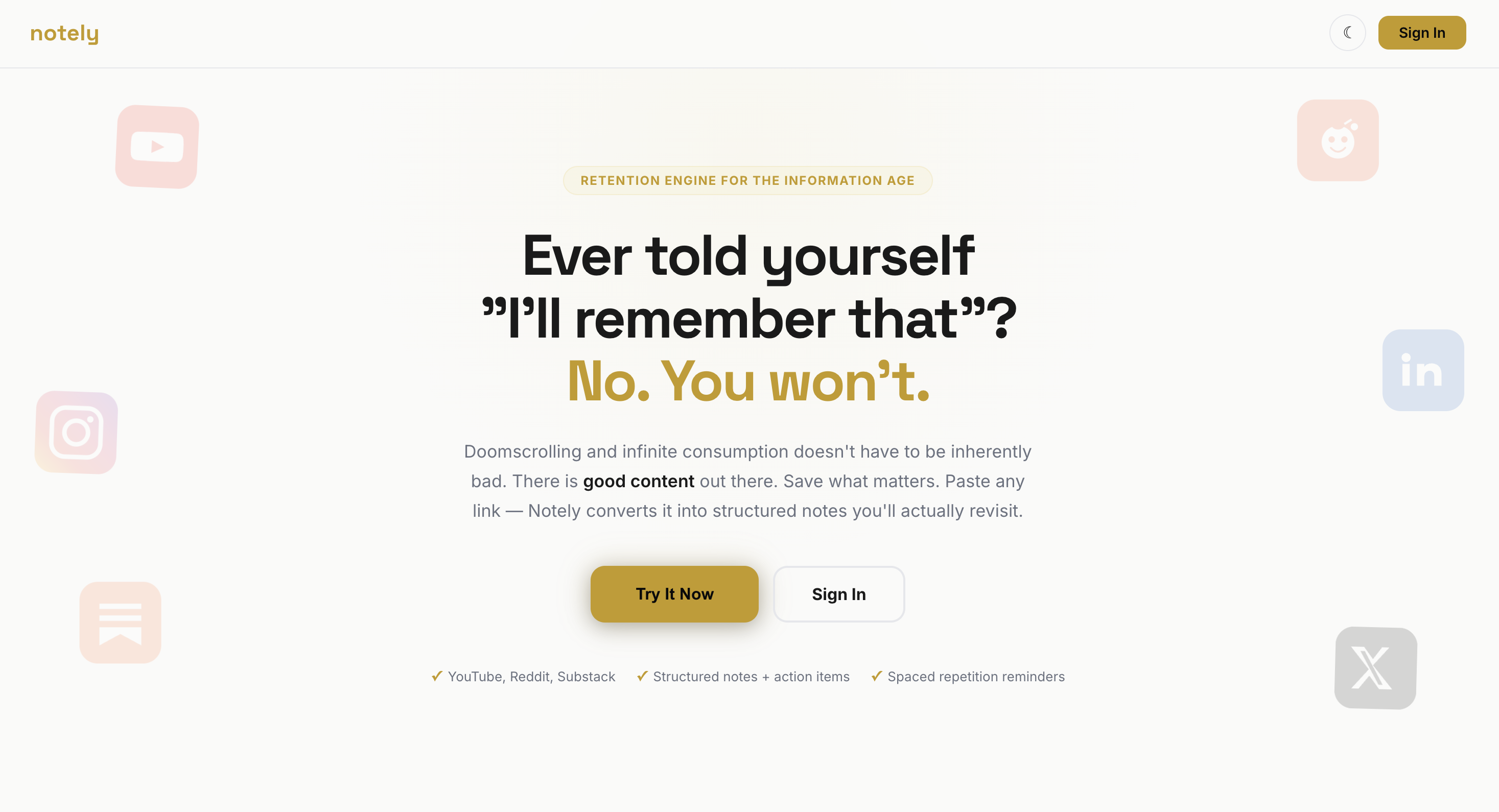
Your second brain for the internet age. Paste any link. Get structured notes. Never forget what you learned.
The Forgetting Problem
The average person consumes 12+ hours of online content weekly. YouTube, Substack, Reddit, Instagram, TikTok, X. The Ebbinghaus forgetting curve shows we lose around 70% of new information within 24 hours and 90% within a week.
But the real problem isn't the forgetting curve. It's the saving illusion. You watch something genuinely useful, think "I need to remember this," save it, and never go back. The watch later playlist that's 200 videos deep. The bookmarks folder you haven't opened in months. The reel you screenshot and forgot about. Best case, you manually type something into your notes, which takes effort, and still doesn't mean you'll remember it later.
We are now consuming at a dangerously fast pace. We're just retaining almost none of it, including the stuff we actually want to remember. Note-taking tools create enough friction at the moment of consumption that most people don't bother consistently. Highlights and saves pile up, unreviewed.
What if there was one place where everything you want to remember actually gets processed, stored properly, and brought back to you at the right time? That's what Notely is.
Summaries Alone Don't Create Memory
The first version of Notely could summarise content. Users liked it. But usage dropped off after the first few sessions. The summaries weren't being revisited.
The key insight: reading a summary once doesn't build long-term retention. The research on spaced repetition (Ebbinghaus, SM2 algorithm) is clear , reviewing material at increasing intervals is the most effective way to commit information to long-term memory.
The product therefore needed two jobs: capture (extract structured notes from any link) and retain (surface those notes again at the right time).
Paste Link → Structured Notes → Scheduled Reviews
Notely is a PWA that works in three steps:
- User pastes any content link (YouTube, Substack, Instagram, Reddit, TikTok, X, or any article)
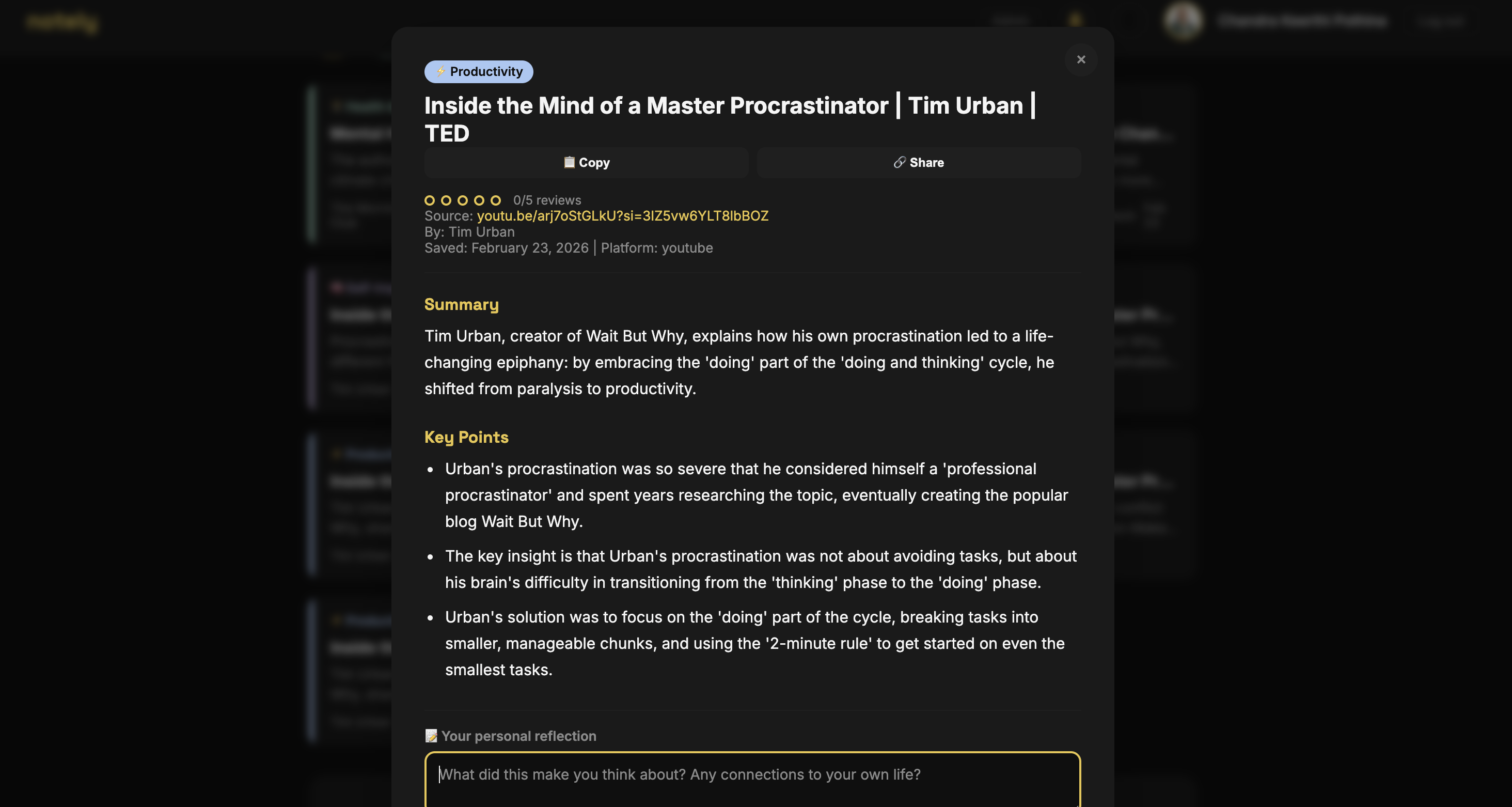
- AI generates structured notes: summary, key points, memorable quotes, action items, auto-categorised by topic
- Spaced repetition schedules review reminders at days 1, 3, 7, 14, and 30, delivered via push notification
Notes are inline-editable (Notion-style, auto-saves on debounce). Users can copy notes in three formats: Markdown, clean text, or text with emojis. The Share Target API means you can share links to Notely directly from any app on iOS or Android.
The SM2 spaced repetition algorithm schedules reviews at days 1, 3, 7, 14, and 30. Streak tracking and push notifications make review a daily habit, not a one-off.
Curious Professionals
Notely is built for high-information consumers: professionals, students, and lifelong learners who consume educational or informational content daily and feel the gap between what they consume and what they retain.
- 18–35 · digitally native · mobile-first
- Follows multiple creators, newsletters, and podcasts
- Values learning but frustrated by poor retention
- Already uses note-taking tools but inconsistently
The "try before you sign up" flow was designed for this user: one free note preview with no account required, then a Google OAuth gate to save. Reduces friction at the critical moment of first value.
Built on Cloudflare's Stack
The entire product runs at the edge on Cloudflare's platform. This was a deliberate architectural choice: global low-latency, zero infrastructure management, and tight integration between compute, database, and AI inference.
The database schema covers: users, notes, topics, sessions, review_schedule, and review_log. A daily cron trigger at 09:00 UTC checks due reviews and dispatches push notifications.
Content extraction is platform-specific: YouTube uses transcript APIs, Substack fetches article HTML, Reddit uses the JSON API, and general web pages are stripped and cleaned. Instagram and TikTok use video transcription services with graceful fallbacks.
Everything
Notely is a solo build. I own every layer:
- Product vision and roadmap (PRD written before a line of code)
- Architecture decisions (edge-native, SQLite, PWA)
- UX design and interaction patterns
- Full-stack TypeScript implementation (863+ lines in v1)
- AI prompt engineering (structured JSON output, topic classification)
- Infrastructure, deployment, and DNS on Cloudflare
- Analytics setup and success metric definition
The product was specced in a full PRD before implementation began, defining P0, P1, and P2 features, database schema, API routes, success metrics, and notification logic. Building it this way made the implementation significantly faster and more coherent.
What Good Looks Like
Success metrics defined at product spec stage:
Live product metrics will be added here as the user base grows. The product is live at itsnotely.com.
Building Solo in Production
- Spec before code. Writing the full PRD, including database schema, success metrics, and notification logic, before writing any code made the implementation dramatically faster. The spec was the architecture.
- User behaviour vs. stated preference. Users said they wanted summaries. What they actually needed was a reason to come back. The spaced repetition system changed the retention curve, and the engagement pattern.
- Platform fragility. Content extraction is brittle. Instagram, TikTok, and X all aggressively block automated access. Building graceful fallbacks and communicating failures clearly was non-trivial.
- Edge-native tradeoffs. Cloudflare's stack is genuinely excellent for this use case, but D1's SQLite limitations (no full-text search, no triggers) required workarounds. Batch processing for the cron job was essential.
- Psychology matters more than features. The streak mechanic and the London Underground-style loading copy ("Reading that for you…") had an outsized effect on user delight relative to the engineering effort.
The insight that stuck: retention is a behaviour design problem, not a feature problem. The notes are just the input. The system that brings you back is the product.